Showing posts with label asana practice. Show all posts

Wednesday, August 24, 2011

Which poses do you find hardest to engage the bandhas?

Source: Yoga Journal
I had no idea my uddiyana bandha was totally not engaged until the teacher came and put his hand on my belly in revolved triangle pose and revolved side angle pose. I normally pay pretty good attention during my sun salutations and non-twists to suck in the belly, but in these poses the twists make it feel like the belly must be sucked in already, since it's squished against the leg (sort of) right? Wrong. I felt like my gut was pushing directly into the teacher's hand and absolutely nothing happened when I tried to order my abdominal muscles to draw the belly back in. Can you imagine how pathetic I felt at that moment? I don't think the belly actually looks that big in twists, but it sure felt like I was 5 months pregnant at that instant. For the rest of the class I was totally self-conscious about my belly in all the twists, and I discovered that I could engage the bandha a little bit in Mari C and D. I don't know if it was because the twists in these poses are kind of lop-sided, providing slightly more space for the ab muscles to maneuver, or did some neural pathway from the brain become established to the abs sometime between the standing series and the seated poses.

So, cybershala, which poses do you feel the easiest to engage the bandhas and which poses are the hardest? For me the easiest pose to feel my bandhas is the 2nd last pose (not counting savasana) -- padmasana. I have heard that bandha engagement should be easy in urdhva padmasana because the organs get out of the way when upside down, but I find it the other way around.. they get in the way of my bandhas (interfering with the diaphram??)  Or maybe I'm just not used to being up side down still.

Don't even ask me about mula bandha. When I worry about it I squeeze everything down there, including unnecessary butt muscles, leg muscles, hip flexor stuff, and a whole bunch of other stuff that I don't know controls what but pretty sure have nothing to do with the perineum.

Monday, August 15, 2011

Drop backs practice report

So I've started doing drop-backs. It's amazing how quickly I've progressed in them. Not saying they're now really nice or anything, but my urdhva dhanurasanas never felt great, so I wasn't expecting to to drop backs so soon. My low back always feels funky in the pose, and I hate it when the teacher says to straighten my legs and shift my chest towards my arms. If I don't do it he'll come and help me and I always feel like I'm about to faint or drown. My neck can never relax in the wheel pose; the neck muscles feel strained whether I try to look up or look down. They refuse to relax no matter how I move my head. Stuff along the spine feels loose, as if the spine will fall apart if I try too hard (but I try hard anyways). Nobel reassured me a little when he told me deep backbends have a spinal alignment effect to them. Not sure if it was Tim Miller or Matthew Sweeney who started the saying, "Backbends are like pancakes. The first two are rubbish." That re-assured me further.

That being said, assisted drop-backs feel a million times safer and easier (psychologically) than attempting drop backs on my own, so kudos to Grimmly and all the people who work on this on their own. I think I sort of tried once at home, and I ended up bending my knees so much I ended up just going into a table top pose instead of a real drop back. Coming back up was like a swim up where I flailed my arms wildly and sort of front crawled my way back to standing, again with super bent knees... I always imagined myself looking like the reverse of Neil doing backbend dodging bullets in the Matrix, except I'm sure it looks a lot dorkier and messier.

Apparently my back is pretty open, so I "don't need to" do hang backs. Actually I just plain can't do them. With the teacher's hands around my waist, for awhile it felt like he was the soul reason I wasn't crashing straight to the floor headfirst since I felt I had zero control over my upper body weight. Coming back up is so much fun with the help of a teacher. A little pull (or pressure into the spine at the low back junction) and I pop right up. But without the teacher I guess I didn't want to look like an idiot doing my front crawl thing in class. I also was really scared of falling back down and landing on my head because my arms wouldn't be ready to catch me or something silly like that.

There are two keys to coming up smoothly: 1. walk the hands as close towards the feet as possible, "past the point where you feel comfortable with placing your hands". 2. Rock back and forth and come up on an inhale while rocking forward towards the feet. So they actually both work, and I've been surprised that some days I can come up on my own. The trick is I have to catch the momentum. If I try to come up at the wrong time during the rock, then I fall back down. My hands did catch me and save me the fate of a head concussion, so my fear was unfounded. If my back feels funny, then I'm not able to walk my hands that close to my feet, and a wide wheel makes coming up impossible.

So now I'm at this inconsistent stage where sometimes I can come up magically on my own no problem, and other times I get stuck in my wheel and can't come up without assistance. Neither the forward bend squish nor the fold itself after the drop backs ever feels long enough, and I can feel my spine screaming "I'm here! Feel my presence!!" at me for the rest of the day. It's not pain.. it's just.. very energized, but not necessarily in a happy or unhappy way. Seriously, who needs a chiropractor if you can just do wheel pose and drop backs? I wonder what chiros think about setu bandhasana and headstands. Setu b. feels super intense right now, probably not from physical strain but from shock. I'm trusting the practice and hoping it'll strengthen my neck and make my neck strain go away. Also hoping matsyasana and uttana padasana will strengthen my mid and low back, because I do not feel peace and calm in these two poses.

Anyways, just a boring recording my practice report. I hope the poses I mention will get easier and my spine will thank me later on. Right now it's questioning what the heck I'm doing to it and the rational brain isn't really sure if what I'm practicing is exactly healthy for my body. I kind of have to have faith, keep at it for a few months and then see what happens.

Tuesday, July 19, 2011

A blog post all about my spine

It doesn't matter what style of yoga you practice; a major body part you work on is your spine. From gentle cat-cow warm ups, to downward/upward facing dog, to sun and moon salutations, to headstands and shoulder stands,  to crazy leg behind the head poses, most yoga poses move the spine in all sorts of directions, in much greater depths than most sports and activities ever require. There are apparently 5 major ways to move your spine: flexion, extension, axial rotation (twists), lateral flexsion (side bends), and axial extension (lengthening). Before I started yoga I thought I had a limber body. Now I feel like I'm finally using my spine the way its intended - built to be curved in so many ways, as long as the muscles, fascia, tendons, ligaments etc coordinate with the vertebrae.

When I started yoga I came to heal my spine. My lower back was hurting me, and when I first started Ashtanga it felt worse. I couldn't tell if I was doing the poses wrong or if my lower back was just weak. I asked the teacher and he said my poses looked okay and he didn't see anything wrong with what I was doing. Primary series was supposed to be therapeutic right? So I tried to suck in my belly button more whenever I felt discomfort in the lumbar spine, hoping the sensation would go away soon. Either that or I would have to quit yoga and switch to some other activity. Thankfully, after 6 months the lower back weirdness went away. So it was indeed a weakness and the primary series helped strengthen my spine in a major way.

Then there was my neck. Ever since I started yoga, I noticed I had a neck ache. I went to see a massage therapist which helped make it better. However after a month the achy-ness came back. I learned it was probably due to the turtle haunch position that I have been assuming in front of my computer screen for the past 10 years. I went to see a chiropractor, which tried to fix my imbalance in terms of left twist vs. right twist, but I felt it was such a money scam because he only worked on me for about 20 minutes at a time and charged me $40 per session, and asked me to go back for 8 more sessions. My yoga teachers adjusted me more than the chiropractor during a 75 minute yoga class, and I pay way less for a class. I tried to lengthen my neck whenever I notice my turtle shrug, but the discomfort persisted. Then I noticed headstands made my neck uncomfortable so I had to stop practicing that at home. I still did it in class but usually only for like 5 breaths and often with the teacher supporting my legs. I notice my neck felt worse when I tried to assume thumb drishti in trikonasana and utthita parsvokonasana, so I stopped looking up in those poses and just focused on lengthening my cervical spine.

Recently, my teacher has been coming by, putting fingers on my back and telling me to engage my lats and pull my back muscles down the spine. Hmm, I can't seem to engage my lats at all. I consciously pull them down for a few breaths, then the next time I check my shoulders are up to my ears again. Sigh. That must be the reason why my neck hurts.

I am just noticing recently that I don't use enough of my back strength in matsyasana. When I engage my back more, uttana padasana suddenly feels a lot harder (I've been arching my back and not engaging back muscles in these 2 poses all this time). So suddenly I am feeling a new sense of strength building in my spine. My headstands are feeling better in the neck, and in setu bandhasana, I am finally taking my elbows off the floor and crossing my arms over my chest. It feels pretty creepy but I can feel strength building in my neck as well. I am really hoping this period of neck strengthening will get rid of the neck discomfort once and for all.

Backbends: now that I am starting to attempt drop backs, I am feeling weirdness in my lower back return. Actually, a few posts back I complained about lumbar spine weirdness in urdhva dhanurasana. So it went away for awhile and I thought I was done with low back strengthening, but I guess I'm not done. I look at my own wheel pose in the mirror and it has such a mild arch, despite how intense it feels. And then I look at pictures of yogis grabbing their ankles in their wheel poses, and I wonder exactly what needs to stretch to get to that point. Kino's article and video suggests that we hang over upside down without touching the mat for a few breaths; I'm sorry but I don't have enough strength to hold it half way. I am either upright with a little back bend or I'm all the way down. There's no in between. Does it mean my back is just too weak?

So many people I've seen come to yoga with a haunch in the shoulder/upper back area. When I look at the pictures of long term ashtanga practitioners, they all seem to have a straight back, and when they bend either forwards or backwards, they bend right at the waist, instead of rounding at the thoracic spine. I don't know if this is the case, but has all these forward bends where the teacher has been helping me flatten my spine on my legs resulted in shifting of imbalances to the upper (neck) and lower (lumbar) part of the spine instead?

One thing's for sure: I definitely need more back strengthening and continue to engage my trapezius and lats to keep my shoulder blades down the back. The fascia and the connective tissue stuff I have no control over; they'll just have to keep restructuring on their own. I wonder if non-Ashtanga yoga styles also re-work the spine in the same way, since most yoga styles I know don't emphasize forward bends.

Friday, July 15, 2011

Back to led practice

Yes, today is a moon day, but I practiced anyway because well, that's when the led class happens. It felt really good to be grounded by my regular practice again, but the entire time I sort of wondered why the heck did I go sooooo fast in my Mysore practice last week? I totally thought I was keeping time to my teacher's normal counting. Either my teacher normally counts faster and he chose to count more slowly today, or alternatively, the burden of counting on my own felt so daunting I just rushed to get it all over with.

It's interesting how the mind works. Today I felt like my mind relaxed and allowed me to focus on how each pose felt at the moment I was holding it. In the Mysore practice it seemed like all my mind could do was to hear my breathing and do counting, that was it. Anything other tasks would become over-burden for the conscious brain. As I got into my janushirsansa b and c, I couldn't help but to wonder: did I even do these 2 poses in my Mysore class? I'm pretty sure I must have done them, but I have zero recollection of feeling my heel pressed into mula bandha, or the toe crunching / achilles tendon stretching sensations that I felt today in class. Did I bother going to my edge at all in my Mysore practice? I think the only perception I could manage besides remembering the sequence was that I felt no pain sensations.

It seems like a significant part of the practice of yoga is to understand our inner workings of our own minds. With this little Mysore back to led practice experiment, I discovered I have major blind spots in my brain. When the brain is occupied with being in an unfamiliar environment and new tasks, it drops the perceptions of less important things, like the details of how each pose feels in different parts of the body. Even though my focus on breathing was much better in the Mysore class (because it was what I used to pace myself) than in a led class, I felt less calm after the practice (more calm than before I practiced, but less calm than practicing at my usual class).  I wonder when I will reach a point where I feel completely at ease and be able to fully enjoy the practice without being my own yoga police, worrying if my bandha's engaged, if my legs are straight, if my neck's crunched, if my shoulders are away from my ears, if my side bodies are lengthened, so on and so forth. I fantasize about a perfect practice with no extraneous muscle strains, everything stays aligned, jump-throughs don't feel like dragging a bag of heavy bricks across the mat, and my breathing feels super smooth. It's something I would like to work towards.

Wednesday, July 13, 2011

My first Mysore class experience

So I recently went to my first ever Mysore class. It felt sooooo different from a led class. It was so hard to concentrate on my own practice when everyone around me is doing something different! I kept miscounting my surya namaskara Bs (accidentally making some of them into surya As). I would also skip a pose, then realize it a few poses later, do that pose, then go back to what I was doing, totally re-ordering the Primary series. I was also totally not used the teacher's adjustments. My usual teacher normally starts with a gentle push, and then deepen the adjustment, holding it for 3-5 breaths, for both sides. The teacher at this shala would give me a 1-2 second squish one side only and walk away. For Mari D I got a non-gentle double shoulder grab - upper body deepening twist that was neither painful nor unsafe, but still left me kind of surprised. I guess I've been too pampered and spoiled in my regular led primary series classes. Supta kurmasana was a towel grab rather than a bind, but this teacher gave a pretty strong adjustment that got my feet crossing above my head, and that felt good. In supta padangusthasana A, usually I pull my leg down to my face, but this teacher held my leg straight in the air and made me come up to meet it. Made the pose feel totally different (ie. much more challenging, which is probably exactly what I needed).

I guess the idea of Mysore classes is to go at your own pace, spending a few more breaths in poses that need more work, and even repeating things that need work. However I felt totally insecure without a teacher verbally going through instructions on things to watch out in each pose, or what was supposed proper pace. I'm too used to being told what to do, so I ended up rushing through the entire series due to nervousness. I think I caught up and surpassed several people who started much earlier than I did. I might have also completely skipped a few poses by accident, but there would be no way to know because I had no memory of what I did and did not do 2 poses earlier, and the teacher wasn't really watching me (the shala was pretty happening). I think I also might have started counting my breaths while I was still getting into each pose, so probably I only held each pose for about 3-4 breaths.

Overall it was a very rushed practice at the fault of no one but myself. It was fun watching people do intermediate poses at close proximity. Hey, don't judge me for my drishti violations; it's my first time experiencing this so I just had to check out poses I'd never seen in real life before. It'll probably take awhile before I get used to Mysore style practice; for now I will stick to led Primary classes (and my regular teacher's handholding style adjustments, hehehe).

Update: I want to stress I'm not dissing Mysore style of practice. This is just my personal experience after over one year of led primary practice with the same teacher. I would happily switch to a Mysore class if my regular led class 5 minutes from where I live no longer becomes available to me.

Friday, July 1, 2011

Recent asana progress summary

Sirsasana - can do it at home okay, but in class I'm having trouble doing it towards the end of class. Takes me quite awhile to mentally prepare before going up, and once I have the pose I can't hold it for long, for fear of falling over and just not enough stamina or something. Claudia talked about 2 kinds of sirsasanas in her blog. I think I like the bregma version at home. In class I seem to do the crown headstand, or whatever version that will permit my feet to lift off the ground and provide a drishti so I don't get distracted by classmates behind me. Balance is a bigger issue than back curvature at the moment. Teacher told me to have my elbows closer together (because apparently they move apart once I'm up in the air. Who knew?) and that helped.

Jump backs - played with blocks today. I can get my legs off the ground with blocks under my hands for added arm length, yay! However, once I'm in lolasana I am completely stuck. I have no momentum for jumping back. Apparently I'm supposed to bend my arms to shift my center of gravity... hmm.. not happening right now. Arms are still not strong enough and ass is so heavy any shift in center of gravity (ie. shift of pelvis in mid-air) results in my body gets confused about what it can and cannot do. 2 solutions -

1. Keep practicing for many more life times.
2. Reduce size of ass (harder to achieve, but I think it'll be sooooo effective). I need a junk food police to hang out with me 24/7.

Forearm stands and handstands - yes yes I know they are not part of the Primary series, but I've been playing with them since I've discovered that achieving them is possible within this life time. Too chicken to do either of them without a wall within reach yet. I feel like my lower back isn't stable enough for me to hold these poses on my own, but it could be more of a mental block than a physical issue.

Urdhva dhanurasana - again, lower back feels unstable. I can feel stuff is moving around in the lower back spinal area, and that creeps me out. Can anyone share with me their experience working on this pose? I can't figure out if it's my spinal discs moving around or if it's my ligaments or whatever else is holding up my spine in that area. I can't distinguish actual pain sensations from soreness/discomfort from strong emotional feelings in this pose.

Chakrasana - exactly how important is the correctness of this move? I've been doing a judo/kung fu backward roll, using all momentum and trying to stay off the head completely. I think the "correct" way of doing this is actually going on the crown of the head a little bit. I haven't gotten any corrections yet, probably because the teacher thinks it's better to try to do some version than not to try it at all.

Bakasana - I seriously thought I'd totally have those pose down after 1 year of yoga practice. It's still difficult after 1.5 years! Another ass-heavy problem? I think I can hold the pose for about 3 breaths before my knees start sliding down my arms. Maybe it's a legs-are-too-heavy problem too.

Supta kurmasana - I can bind finger tips now! This is happening after I've been instructed to bind my wrist in all marichyasanas rather than just clasping my fingers together. I'm literally pulling my hand slightly out of its socket in every bind.. is that healthy for the joint? I can also cross my feet above my head, but not at the same time as binding my fingers. It's one or the other right now. Doing both simultaneously is considered as multi-tasking and too complex for my body/brain to handle.

General body issues - hips often feel over-stretched. Upper back between the shoulder blades are often sore; lower back feels a little lose, like it could use more strengthening. Sinus often feels kind of blocked. Neck always has issues. muscles around elbow area do not like the amount of chaturangas I put them through.  Gee, with this much complaints, my non-yogi friends for sure would advise me to stop with all this yoga madness. I'm hoping when I read this entry 6-12 months from now I'll be able to answer all of my own questions and provide better insights into whether or not my body issues have improved.

Friday, April 15, 2011

Ashtanga practice... finally doing (almost) the full Primary series!

Ashtanga practice update in point form:

- Question: does anyone else find it difficult to hold up the arm in utthita parsvakonasana B? The arm just feels insanely heavy and my shoulder burns in this pose. I kept expecting it to go away as my shoulder becomes stronger but it's still there after many months of practicing the full pose.

- Prasarita Paddottanasana C: I thought normal human beings are not meant to actually touch their hands to the ground, or something would tear in the shoulders; but my teacher got my fingers to touch the ground with slow but steady pushing after 5 breaths. So okay, with someone pushing on my arms this can happen. But after a few assists I suddenly found myself being able to do this without assistance. Freaky!

- Mari D: left side binding is totally inconsistent (some days I get it and other days I don't); no idea why

- Kurmasansa: heel lift is consistent, but holding for 5 breaths feels impossible. I aim for 2 breaths and then just give up

- Supta kurmasana: my teacher said when he first learned this pose, he felt pain/discomfort in the upper sternum near the collar bone area. I said I wasn't feeling it when I first started practicing this pose. I'm feeling it now! Does this mean I'm getting closer to achieving the actual pose?

- Garbha pindasana: not happening unless I lose a few pounds of meat on my thighs. I have NOT lost any weight since I started yoga! Does this mean I have to start dieting?

- I just started doing the rolls (like 2 weeks ago). Can't even get all the way around in 9 moves so there's no way I'll be able to pull off 5 rolls. I'll stick with 9 (or 10) for now.

- Teacher still hasn't taught chakrasana yet; I searched a few Youtube videos today and am going to try to learn it on my own (I'm really impatient) By the way, do non-Ashtangis call urdhva dhanurasana -> chakrasana? It was not that easy to find actual chakrasana transition videos.

- In place of no chakrasana, teacher tried to teach me padmasana jump-backs today. I started laughing uncontrollably when I heard the instruction "make cleavage with your elbows" so I was unsuccessful with this move.

- Just learned setu bandhasana today. Definitely feels weird. Oh well, new pose to work on!

- Utpluthih: I can lift off the ground for a few breaths now. Exciting!!

I once had a massage therapist who pushed his forearm hard on my back and ran it all the way down the spine (perpendicular to spine). Lots of cracks and pops were generated from this technique, which was kind of scary, but afterwards the back felt awesome. I could use that chiropractic adjustment again right about now.

Sunday, March 27, 2011

Back!

Thoughts after 1 week away from my blog:

- It was tough, but probably wouldn't be as tough as an attempt to leaving Facebook for 1 week
- I ended up doing more tweeting on thoughts on yoga
- I sort of succeeded in resisting to read people's yoga blog, but probably only because I don't have a neat one-stop shop Google Reader set-up
- I couldn't resist going to Elephant Journal to get my "fix" on yoga-related articles
- I saved a little bit of time, but I still found other ways to procrastinate.

Conclusion:
It's not about cutting down blogging time or blog reading time. It's about getting my mind to focus so I don't substitute one time waster for another :P


-------------------
Asana progress: my teacher got me to bind in Yoga mudra! I just decided to grab my toe on one side (instead of the usual elbow hugging), thinking the other side will have to wait another 6 months, and then the teacher came and connected my other hand to my other toe, just like that. That was ridiculously easy. Ok maybe not that easy. Maybe I just have high pain tolerance. Actually, it wasn't even painful. I just got a little scared because I thought it should have been painful (something wrong with my injury -> pain feedback system?! Talk about paranoia).

I'm learning that I like to set unfounded artificial boundaries, rules and limits for myself.

"I'll get hurt if I dare to try this pose"
"There's no way I can do this pose because my arms aren't strong enough"
"I can't do yoga two days in a row because my body can't handle it"
"I can't try this activity because it's too challenging for me and my parents wouldn't approve"
"I shouldn't try x because I risk losing a/b/c/d/e/f/g"

There are people out there who need parental / societal / legal restraints or they will harm others or themselves. For me, my own set of rules can be much stricter than the ones enforced by law (or by physiological limitations).

Something to ponder about and try to break free from. I've got the rest of my life to work on this one.

Thursday, March 10, 2011

No tiny yoga shorts in my class today :( :( :(

I looked around in my classroom today and noticed that not a single person wore short shorts! None of the women wore anything shorter than crop pants. The guys either wore super long shorts that went all the way below the knees (basketball shorts I think), or bicycle shorts, or shorts that covered at least half the the thighs. I was kind of disappointed :( I swear I've seen women in sports bras at least and somewhat short shorts (butt cheeks still covered) in yoga classes before, but I guess today in particular was a G-rated, family-friendly class. Sad.

=========================================================================

Onwards! A bit about dristi. I try hard to stare at my own nose, but truth is, I'm fascinated by everyone's body types, athletic backgrounds, flexibility levels, teacher's personalized adjustments for each individual, asana progresses, so on and so on. What can I say, I am super curious! I generally keep my head facing in the direction of the drishti but my eyes are constantly checking these things out. I just learned today that for Mari C, the head faces straight behind, but the drishi should still be on the nose. LOL, no wonder I've been feeling super awkward having to look eye-to-eye at all the people behind me this entire time I've been practicing this series! The thing is, people in this class have worse drishti than I do. Even for people who are stiff as a board, shouldn't they at least be looking towards the side wall, rather than staring straight at me? How the heck do you do a twist when you're still facing forward?

Hmm, never mind, I just tried it; it's still possible to do a twist while looking ahead, but good luck getting deeper into the pose (especially without a bind)!

Oh, and for Karnapidasana + Pindasana, the drishi is what, navel? So why do I find myself staring at the anti-camel toe patch on my pants instead? It's better than the alternative of what I'd be staring at if the patch weren't there I guess.

I realize drishi for forward folds is the big toe, but right now I'm just looking down at my large thighs because I'm having neck strain issues. I can't figure out if I'm straining my neck from yoga or if it's from bad postures working long hours in front of the computer. It's probably a mixture of both. Anyways, forehead kissing my knees right now until my neck improves, which could take awhile.

Drishi's definitely necessary in a classroom setting. Otherwise I'd be admiring people's fashion instead. Oh wait, I do that anyways. I guess I've always been admiring people's cute tanks tops and new hair styles. Today was the first time I paid attention to people's shorts, which seemed to be not as short I'd expected :D

Yah I know, my dharana, pranayama and pratyahara kind of suffer with this bad habit, but I think if I take yoga too seriously there's the danger of getting tired of it some day. Never know if that day will come, but I don't want it to come too soon. Still fascinated with many aspects of Ashtanga right now.

Tuesday, March 8, 2011

Addicted to prana

I took a couple power yoga classes with alternative teachers recently, due to social reasons. Yes, yoga is like a social activity for me now. Some people go clubbing or go for coffee with friends; I go to various studios for yoga classes with friends whom I haven't seen for awhile. I also try to attend classes of people who have newly gotten their teacher training certifications. It's my way of showing support for fresh new teachers and racking up karma points. I used to get disappointed if people don't reciprocate the favors, but now I've learned that karma is not about how others returning the favors; it's about how I feel about my own chosen actions, which should be a reward in itself.

Anyways, there was one class that was nothing like Ashtanga but I really enjoyed it, and another that I honestly hated. I was wondering why I had such adverse reactions to certain power classes even though I  really appreciate the teachers' enthusiasm and efforts. The initial criteria that come to mind are the sequencing of asanas, the pace and rhythm with which the teacher takes us into poses, and the clarity of the teacher's instructions. After today's gorgeous Ashtanga class, another answer dawned on me: I am addicted to the generation of prana in yoga classes.

To me, if there's no linking of breath to movement, it should not be considered as a yoga class. I guess many of the new teachers, especially those with fitness backgrounds, are too eager to challenge the students, making them hold a tough pose for what seems to be an eternity, or sequence the poses in a way they might as well label as circus or bootcamp training. It's nice that the class challenges the muscles, but the fact that I cannot breath with my movements through the asana sequence they designed bugs me like crazy! I noticed in today's Ashtanga class that the strong ujjayi breathing carried me through tough poses/vinyasas and half way through the sequence I felt energized by my breathing, and had higher energy than at the beginning of class! I think sometimes a teacher's enthusiasm can uplift the entire class (like my rocket yoga classes), and for today's case my own breathing helped me build up more energy. With the power class I liked, I'm not sure if it was the teacher's Anusara training or his martial arts background, but even though he broke his class up into different segments with pauses in between (where I learned to get into a handstand with assists, woohoo!), he seemed to pay a lot of attention to breathing and energy flow in the warm up and cool down sequences.

So, I guess the verdict is that I'm a breathing/prana junkie. For my friends who are not fans of Ashtanga, or who love power classes for the sheer challenge on the muscular body, I'm guessing they haven't really experienced a really good pranyama practice yet. I also appreciate that one first needs to be able to comfortably get into a good proportion of the poses in Asthanga before being able to enjoy an ease of rhythmic breathing, and that takes a good period of dedicated regular practice.

p.s. For my personal record, my heels lifted a millimeter off the ground for kurmasana today for the first time. Woohoo :)

Thursday, February 17, 2011

Ashtanga practice ramblings

My hammies really got stretched at practice, in multiple poses. I find it hard to balance in uttiha hasta padagustasana since I tend to try too hard in the previous pose (Parsvottanasana). Should back off a bit in pyramid and see if my UHPs would improve. At least I haven't been suffering from blinding dizziness coming out of standing forward folds recently (still dizzy, but not blinded). Had trouble binding on the left side of Mari D. I guess self-pretzeling is much harder than teacher-assisted pretzels. Binding in supta kurmasana is also inconsistent. I actually wouldn't mind doing this pose in a half-assed fashion and move on with life (sorry about the language), but my teacher's determined to get me to accomplish this pose within the foreseeable future.  Coming out of the pose and lifting up into titibasana was pretty disastrous, even with the teacher's assistance. My arms felt like jelly after trying so hard to bind. I also got corrected in my toe tuck technique for my vinyasas. I thought this was a bit nit-picking but the teacher said my alternate toe flipping method was probably the reason my chaturangas arms were uneven. OH!!! This whole time ever since I started yoga I just thought I had uneven arm strengths.

I love my Ashtanga practice - the accomplishments as well as the difficulties.

Wednesday, February 2, 2011

An Ashtanga yoga practice report

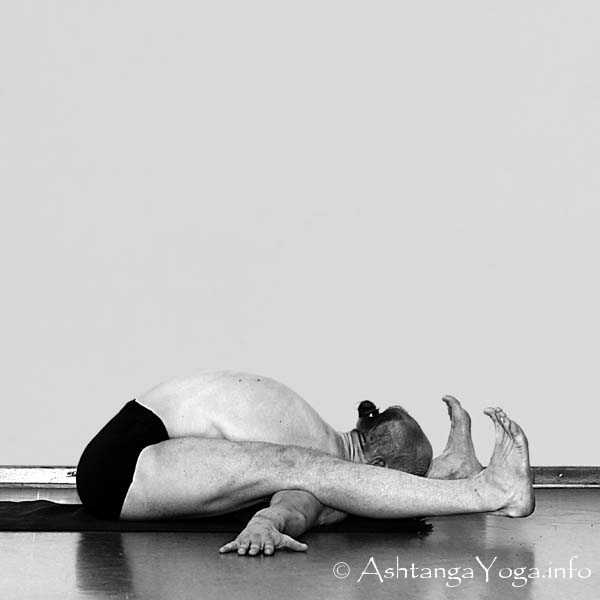
Kurmasana and supta kurmasana are not my favorite poses among the Primary series. I feel pretty ridiculous, not to mention trapped in these two poses.  In martial arts, one of the major joint lock techniques is the "arm bar" -- locking of the elbow.  The idea is to apply pressure to your opponent's straight arm, about 2-3 inches above the elbow, pushing down while forcing the forearm to go in the opposite direction of how the elbow is supposed to bend normally.  When applied correctly, I've been told it only takes about 7 pounds of pressure to break the arm (don't quote me on this one). The first time I tried kurmasana, I felt like I was essentially giving myself a double arm bar using the weight of my own legs. Can you hear me scream "Panic!" and "Dislike!" in my head?  I guess the upside is that if I ever decide that I hate my arms so much I don't want them any more, I've now learned the perfect yoga pose to break them off, without the need for any external help! Hooray?

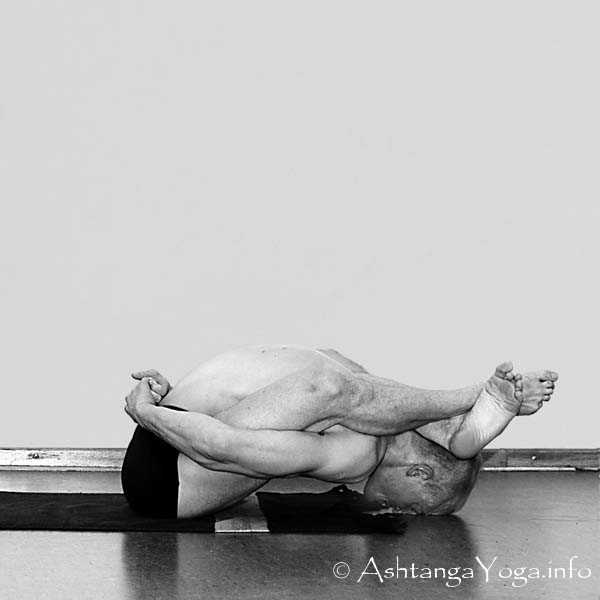
Supta kurmasana is even more ridiculous. I guess there is no longer an arm lock component (since we can bend our knees) so at least this pose doesn't scream "danger" to me. However, as if having my arms stuck under my legs do not make me feel trapped enough, I'm supposed wrap my arms around my elephant-sized legs and hippo-sized arse and clasp my fingers behind my back?  Just in case I can still manage some sort of faint breathing, I now have to hook my feet together at the ankle and try to put them over my head, so my face can be pushed further into the mat and cut off all air sources? Nice. A yoga pose for self-suffocation.

As you can imagine, I don't practice these two poses at all outside of class. Okay that's not true. I've tried them at home but felt ridiculous, or rather, labeled them ridiculous and hence felt that way.  We don't really do these 2 poses in class that often, but whenever we do them, my teacher often likes to come over, adjust my shoulders, try to stuff my arms further under my legs, and then walk behind me trying to get my hands to bind behind my back, with no success. With my face pressed into the mat, I can only manage a muffled whimper rather than a formal complaint.  This situation brings up in my mind an image of myself as a helpless turkey being stuffed and tied up, and I burst into laughter at the silly image. Well... the pose doesn't really permit me to laugh out loud, so imagine the whole stuffed turkey vibrating from stifled giggles. Sigh...  I must be the most ridiculous looking yogi in the classroom.

How I picture myself in supta kurmasana (minus the garnishes)
Anyways, with this much negative feelings towards these poses, I figured I won't experience much improvements with them any times soon. Surprisingly, at practice the other day, I felt that my heels could come off the ground briefly in kurmasana, with no pain on my elbows! Actually I've always experienced no pain with my elbows; I just imagined they would be painful if I applied more pressure to my arms with my legs. Again the teacher came to try to bind me in supta kurmasana, and this time, my fingers touched! Nope I have not lost any weight. Perhaps my legs have become squishier?

After class I went to the teacher to get my acknowledgement like a good golden retriever, and he said he was glad that prasarita padottanasana B and C have been helping me getting into the pose (by opening up the chest and shoulder muscles). What?! I never realized the connection between those poses and supta kuramasana! Sneaky Ashtanga system.. helping me improve in poses I dislike without me actually practicing them. Let this be a warning to you all: if you keep doing the entire Ashtanga primary series, regardless of your current flexibility levels, you'll accidentally get better at poses that you've never planned to master!

Monday, November 29, 2010

The elusive headstand

Ah, the elusive sirsasana - climax of the Primary Series. It seems like the pose to conquer. It make my neck uncomfortable, but for the past few months, I can't seem to stop attempting the pose whenever I can! Talk about OCD....

[Addendum: Preparatory steps before attempting a headstand

I know I know, everyone wants to attempt a headstand right away. It looks cool and you want to try it out, even if it means falling on your face during your first attempt! I wasn't that brave, but I did want to start practicing the full version as soon as possible. However, my awesome teacher, having observed many headstand-related neck issues, made us practice the dolphin pose each class and told us that we should not start practicing the headstand until we could hold this pose for 30 breaths.  How to practice the dolphin pose: head completely off the ground, support body weight on forearms and shoulders, fingers loosely interlaced, slowly walk the legs closer towards the arms until your body feels vertical (shoulders over elbows) and your feet are on tippy toes. This pose does NOT feel good... in fact, it feels a lot less comfortable than doing the actual headstand. However it's way safer and builds strength in your arms and shoulders required to do a safe headstand. ]

Yes I realize I should put 90% body weight on my forearms/elbows, only 10% pressure on my head, but once my legs are off the ground, my attention goes to the dangling legs and the body, and my poor head and neck are sadly neglected until my feet land on the ground again. I mean, I can feel my head and neck being somewhat uncomfortable the whole time, but my mind says to them, "You guys shut up! Quit complainin' will ya? Just stay put and support the rest of the body! You're on the ground so you're safe. I'm going to worry about the moving body parts instead." I'm not very nice to myself I guess.. that's probably why my neck has been sore for the last few weeks :p

My teacher teaches the version where both legs rise up slowly together. Some people kick one leg up and then try to get the other leg to meet the one up in the air. For some unknown reason my teacher discourages that, so I've been practicing it his way. When I try it at home, I could feel tremendous engagement in my abdomen and psoas, and then as the legs rise up, at some point the abs and psoas seem to lose the intense engagement with the legs, and then I panic and either smash my feet into the wall if I'm near one, or, if I practice it in the middle of the room, my legs kick wildly, losing balance, then I roll over jamming my interlaced fingers. Yay clumsy me! Thank goodness for thick carpets. [ To avoid rolling your head on your interlaced fingers (ouchy knuckles), tuck your chin into your chest if you end up falling over ].

It's fun to practice the pose with someone spotting me in class. Feels very different than practicing next to a wall. I don't really know why the hands guiding the hips help so much. I used to think that it was my teacher lifting my legs up in the air, but if I really think about it, that's a lot of weight to lift up with just a few fingers. So really, they just act as guides for my mental security, but they seem to help so much! Also, I used to practice to lift my legs until they make contact with the wall. Not a very good habit because I always rely on the wall being there. The mischievous yoga teacher, on the other hand, lets me make contact, then moves away, causing me to go into a major panic mode before giving me his shoulder or hand support again. It always felt like a disaster (sometimes he doesn't manage to catch my legs so they come crashing down), but a classmate behind me told me after class recently that I had a nice-looking free headstand.. huh? Really? I managed to stay upright on my own for an observable amount of time? Yay! Certainly didn't feel that way while I was in the pose, but thanks!

After a few weeks of struggling with up-side-down balance, I can now do a free headstand at home! Yay! The trick is to not panic when I feel I lose my core engagement when my legs are about 10-20 degrees from the vertical line. Trust that my legs are already up in the air, and let my body (and head) do their balancing act. Then work on trying to straighten the legs. Actually I have no idea if my body is straight or not because I can't see myself in a mirror. Right now I still can't do it in class without a spotter because I'm usually too exhausted 2/3 way through the Primary series. Hopefully in the next few weeks (or early next year) I'll be able to get it in the classroom, without assistance (and not fall on anybody)! Someone fell on me once; I think that's why I hesitate to be more daring in class.

Yoga. is. fun. Makes me feel like I'm still a kid, which I still feel like one at the age of 30.

[Addendum: As Loo pointed out in the comments below, I did *not* anticipate that even after I have built enough arm/shoulder strength practicing the dolphin pose, it's still possible to put too much weight on my head due to negligence/laziness. That's when this whole blogging / getting feedback from the online yoga community thing comes in handy :) ]